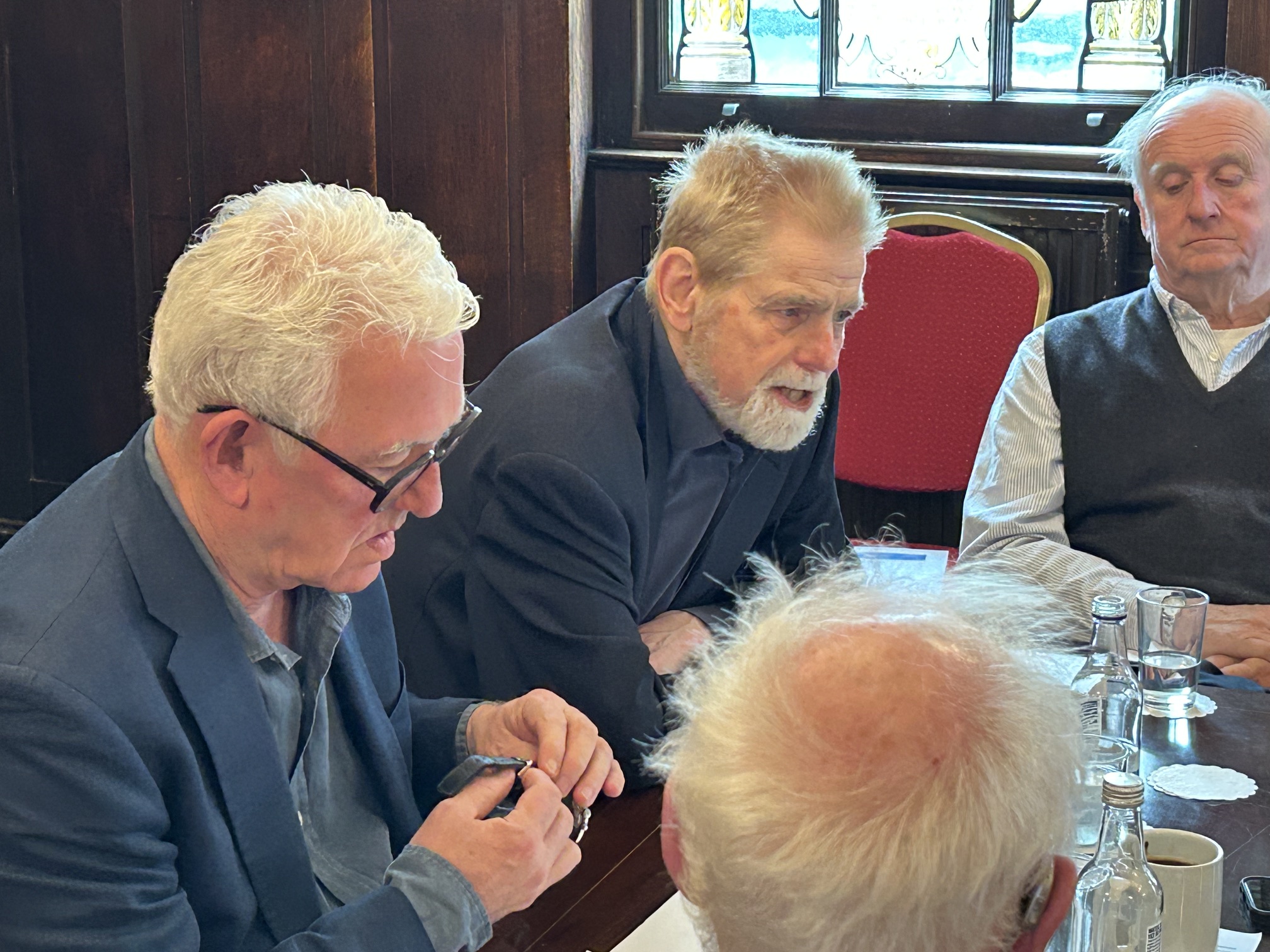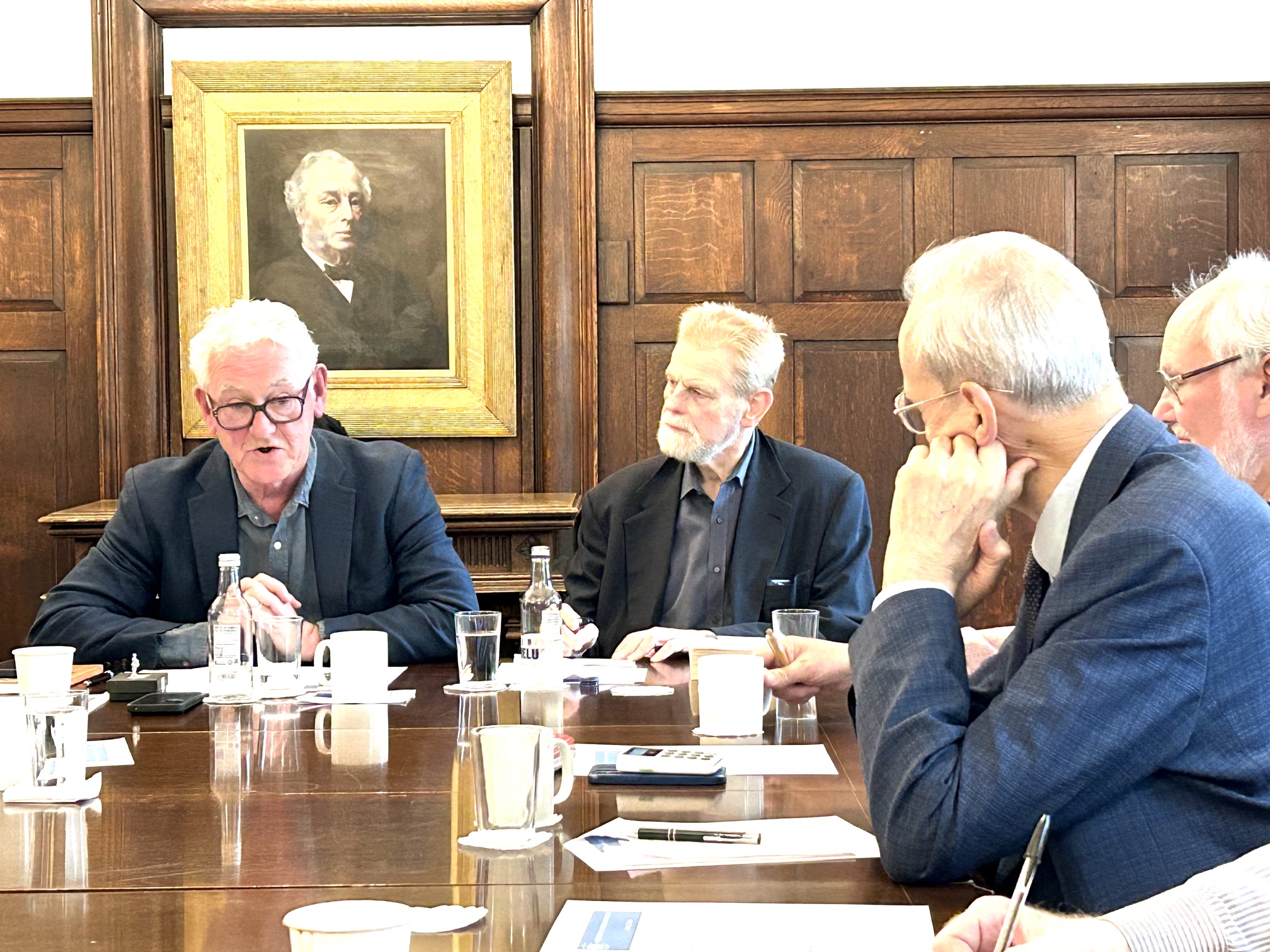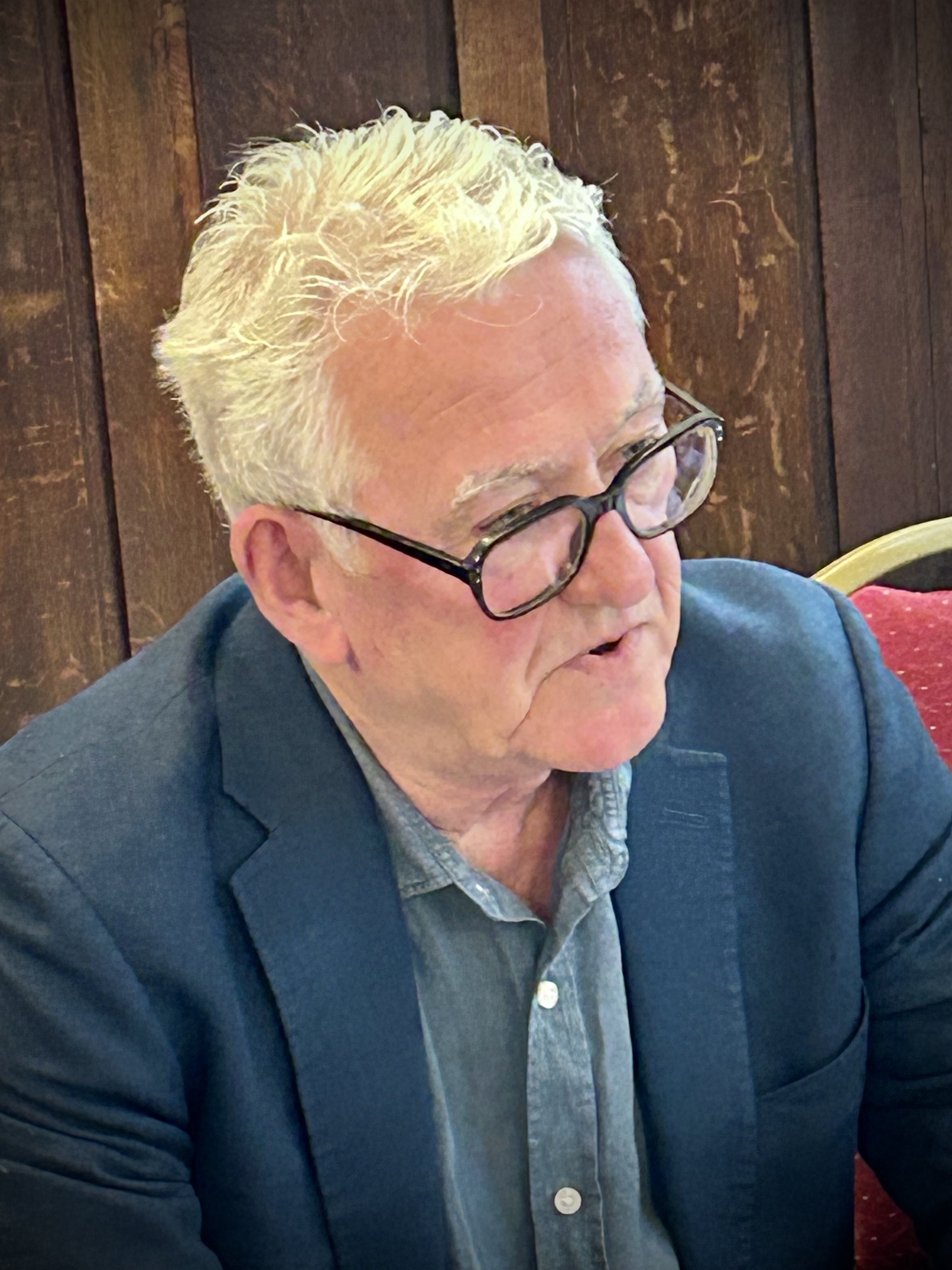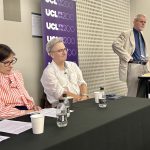
The AEJ UK hosted eminent historian and commentator Michael Burleigh at a meeting on June 4.
Burleigh is the author of highly acclaimed books including Small Wars, Faraway Places: The Genesis of the Modern World , 1945-65 (2013); The Third Reich: A New History (2000) and Populism (2021).
At this meeting with AEJ members and guests, historian Michael Burleigh shared penetrating insights into the uses and abuses of history, shedding light on how despots and strongmen leaders have ruthlessly manipulated the record of past events and instrumentalised national myths for propaganda purposes up to the present day. His analysis exposes how historians and journalists alike have propagated powerful narratives which can have far-reaching influence of a malign or a benign kind. Burleigh finds that our democracies are poor at communicating the need for institutional structures which maintain the rule of law against state arbitrariness. Sometimes, he says, “History needs to be unlearned too”.
The full text of Michael Burleigh’s opening remarks are available here:
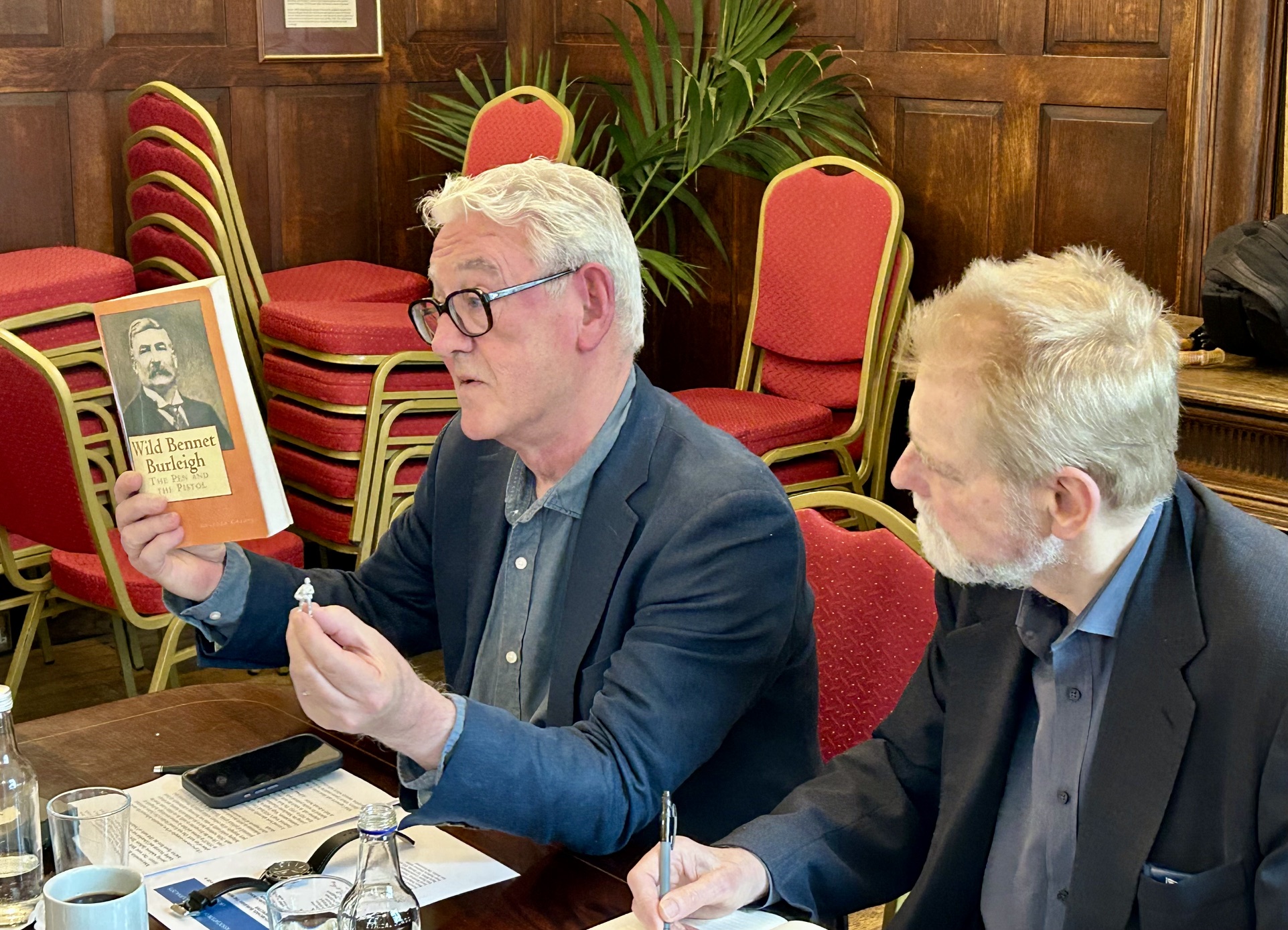
What journalists have to say has always been important to how I write History. They were ‘there’ and their work did not have to nod towards passing academic fashions. Here’s one of them – my grandfather, a leading Victorian and Edwardian war correspondent, rendered as a lead toy figure from the 1898 battle of Omdurman.
I’ll give you two examples of how journalists influenced the earlier phase of my work. One was Konrad Heiden’s Der Fuhrer, published in 1936/37 in German and then in various reworkings in English in 1944. He was the first reporter to really be on Hitler’s case from the early 1920s, venturing back to his childhood in Austria, and always bringing sordid reality to what was becoming a deliberately stylised party biography of the ordinary soldier guided by Providence and possessed of political genius. Heiden had to flee in 1933; his book stops a year later with an event that June which suggests all the murderousness would ensue for the next decade.
A second book also really influenced my own approach. It was Frederick Voigt’s 1938 book Unto Caesar. Born in London to émigré German parents, Voigt fought in the British army in WW1 before joining the Manchester Guardian. He covered Germany for the paper from 1920 to 1933. The book treats Nazism as a plangent pseudo religious cult, in which the tools and tricks of religiosity are liberally hijacked for secular political ends. Mussolini has done much the same in Italy a decade before.
Voigt had taken the trouble to go through all the Weimar newspapers for about ten years. And you’d think Mussolini would have been the big news of the day. Not a bit of it. Every newspaper was full of stuff about Kemal Ataturk. And there were two very good reasons for this. First, Ataturk was the only person who successfully overturned one of the Versailles parallel treaties. Sevres got overturned, and then Lausanne replaced it, and the Germans found this absolutely fascinating. And the other thing they liked about him was that the Turkey that emerged from the Ottoman empire was much more ethnically homogeneous – to put it euphemistically – and he had created this almost racial state with ethnic Turks, and the minorities, whether they were Greeks or Armenians, had gone. What an extraordinary thing that you could learn from studying the newspapers of the time.
What I agreed to talk about today is the use, abuses and limitations of History, which I guess could be broken down into the academic discipline, memory which individuals, peoples and states have, and myths which can be malign or benign. Of course, these categories are fluid, for there have been many ultra nationalist historians, while the role of my profession has been flatteringly compared with woodworm chewing its way into the timbers of myth. Nowadays we also have history as entertainment – on podcasts and in festivals – or indeed ‘anti-History’ where black is turned into white and conspiracies abound.
People often say we live in an age of strongmen, notably Trump, Putin and Xi. Of the three, Trump is the least historically aware, save for his evanescent enthusiasms for Presidents Andrew Jackson or William McKinley and his tariffs. This is because he is entirely comfortable in not knowing what he doesn’t know, except when he can put his name on it as in Donroe Doctrine or even Trump Corollary. Possibly the most interesting book about Trump is called Audience of One by a New York Times TV critic, which explains Trump’s lifelong fascination with that medium which made him a celebrity. Future historians will have to ponder – for Trump is moving to own documents which should be in the National Archives – how many decisions – including personnel choices – came about as he lumbered through a White House as reimagined by Liberace, pausing to take in a face or a chyron on the multiple flat screen TVs. They will also have to ponder any number of rather forced comparisons between Trump and Augustus Caesar, Mussolini, Hitler or Richard Nixon (popular among his apologists) whereas he is merely a celebrity who built a movement where others – Pat Buchanan and Ross Perot among them – had tried and failed. John Ganz wrote a fascinating book, called When the Clock Broke, showing why those harbingers did not have Trump’s magic formula
Xi is without doubt the most historically informed of the three strongmen. As Kevin Rudd’s enormous Oxford PhD thesis shows, Xi is steeped in the history of Marxist-Leninism, and as the son of Xi Zhongxun, he is also intimately familiar with the history of the Chinese Communist Party, which saw his father rise and fall and rise again. Knowing that history was literally a matter of life and death, for this very taciturn man who weighs words very carefully rather than spewing them out like spit.
As a brilliant biography by Joseph Torigian shows, the key enigma of both Xi and his father is their unwavering loyalty to a party which in its very worst phase beat the father so hard he lost his hearing in one ear, while Xi’s sister hung herself. At one criticism session, the teenage Xi had to listen as his own mother joined in a party mob denouncing him as he stood on a stage. Xi has constantly inveighed against what he and the party call ‘historical nihilism’. In 2012 he instituted a hotline and website where examples of it could be anonymously denounced. Nihilism means anything that deviates from the official version, whose words are constantly subtly changed. It needs to be obliterated since Xi believes that critical accounts of the history of the Soviet Union were partly responsible for that system’s downfall in 1989-90. Every Chinese party member gets a DVD set explaining that catastrophe.
But Xi has also implicitly recognised that the rote ingestion of Marxism and CCP history have little purchase on young people. To that end, Xi has presided over the ‘second integration’ of Confucianism, both as a domestic stabiliser because of the stress on family and loyalty, but also as a supposedly harmonious solution to both ecological threats – the soft sell to the rest of us – and the prospect of a reversion to the law of the jungle in the international arena. Even though China is a superpower this official history has a huge element of victim history – as expressed by the term ‘century of national humiliation’ at the hands of outside imperialist powers. Of course China was never actually a colony in any formal sense, and the Qing dynasty had massively expanded China’s territorial area in the nineteenth century.
‘National humiliation’ has an interesting history in itself. The term was used very extensively by the Nationalists- who in 1915 introduced a National Humiliation Day with books of maps charting the Geography of National Humiliation. The crimes of the Japanese from 1931/37 to 1945 were then added on like a kind of coda or epilogue. Strikingly, between 1947 and 1990 there were no books on national humiliation, for under Mao narrow patriotism and nationalism were condemned in favour of international class struggle. Desirous of Japanese capital and know-how, when Deng Xiaoping visited Tokyo he just referred to the Sino-Japanese war as an ‘unfortunate period’ in their relations, and he didn’t say anything more about it.
All this changed in about 1990. History rather than Marxism is now mandatory, as are visits to the 10,000 or so memorials which have sprung up in commemoration of the depredations of the Japanese. The further the crimes of the Japanese retreat, the more big media – like block buster cinema – focuses on the horrors, triggering what amount to mass hate sessions of an Orwellian kind, the theme of perpetual re-traumatisation being one I will come back to.
Then there are the Russians, of whom a celebrated Ukrainian historian observed in 2022: Russia is not overcoming the past, Russia is sinking deeper and deeper into it, like in a swamp. Russia is an example of how too much history can do harm. When memory becomes not an indication of the future, but a toxic material that draws back into the past. Most states try to shape a national story. But there is only one state where the leader’s personal confessor Metropolitan Tikhon collaborates with the energy giant Gazprom to tell that story in a major touring exhibition. Putin himself is a keen scholar of history – in 2021 he wrote a 5000-word essay about it, or rather why there never was and never will be an independent, democratic, Europe-oriented Ukraine. Putin is but one exponent of what you might call civilisational history, meaning something grandiose sounding which can encompass multiple states. It is not very original since Russia’s autocratic barbarity has often been favourably contrasted with the more advanced but decadent liberal West.
But this is not the only history that obsesses Putin, though it is worth noting that Russia is like England in the sense that the dominant nationality’s identity was deliberately suppressed in favour of a heterogeneous Soviet identity and a British union of four kingdoms.
Like the British, Putin is also obsessed with World War Two – or rather the Great Patriotic War – hardly surprising since his older brother Viktor died of diphtheria in Leningrad in 1942. Putin also has a very British fascination with spies. As a lifelong Chekist, his real obsession is with the various incarnations of the secret police, from the Oprichniks (subject of a great 2006 novel by Vladimir Sorokin ) to the Ochrana, to the NKVD (in which Putin’s cook father served), OGPU, the KGB and the FSB and SVR of the present. What other country has an official Security Agency Worker’s Day? On 20th December since you were wondering – since 1995.
So far I’ve been talking about how the strongmen view history. No room there for the institutional buttressing structures which maintain the rule of law against state arbitrariness – a subject our democracies are incredibly poor at communicating to ordinary people.
But sometimes History needs to be unlearned too. Ever since just after I was born in 1955, the year before the Suez crisis, I have heard every opponent the British have alighted upon -Nasser, Galtieri, Gaddafi, Saddam, the Iranian Ayatollahs, Putin – described as Hitlers who must never be appeased as if we are living in a perpetual 1938. Actually, there are historians who make a respectable case for appeasement – military overstretch, the need to rearm and so on – and the answer to every problem is not a hammer on a nail but calm, persistent diplomacy and statecraft. It is also the case that all bar one of these figures were never an existential threat to the UK. This leads to an instinctual belligerence, sadly not least in our media. The degenerated result is politicians who feel compelled to ‘take up the rifle’ or who wish to win ‘beachheads’ in Red or Blue Wall territory as if they in wartime Normandy not Huddersfield or Stockport.
Less parochially, History is also regularly misused in the service of collective victimhood, which I have mentioned in the case of the Chinese. It is a kind of washing of the soul which then permits the most egregious of crimes by erstwhile victims. I’m obviously thinking here of how the Holocaust – at least since the Eichmann trial in 1961 – has been taken up as the ultimate justification not just for a Jewish state in Israel, but to license acts of genocidal barbarity in Gaza or Southern Lebanon, and towards the West Bank Palestinians too. If you imagine your enemies are all Nazis bent on destroying you, then any means are apparently legitimate to combat them- with constant auto traumatisation about the Holocaust resulting not in tolerance and the like but in a lack of interest or empathy regarding Palestinians. My old friend Omar Bartov explicitly compares this to the amoral indifference one can see in the movie Zone of Interest where whatever happens behind a wall stays behind a wall.
Ironically something similar informs the world view of the men who run Iran. All visible in the Pond of Blood in the martyrs’ section of Tehran’s biggest cemetery where even the fountain ran red.
Their dominant experience is not the 1979 Revolution – let alone the ouster of Mossadeq in 1953, which the clergy heartily supported – but the 1980-88 war with Iraq, the core experience of the Revolutionary Guard commanders – who thanks to Trump are now in sole charge of Iran. That experience is the ongoing justification for the national strategy of resistance and forward defence even if the cost has been the economic ruination of ordinary Iranians. – 75 per cent of whom depend on state handouts from a totally corrupt regime.
Anyway, I’ve been talking for too long, about a subject you will all have views on. As humans I can’t see any alternative to thinking historically about the present or future. Better to be guided by an expert through a forest than to blunder around in circles led by idiots. I am also quite content to be that insignificant woodworm in the timbers at a time when devotees of ‘applied history’ such as Graham Allison with his absurd Thucydides Trap would like to be sitting in cabinet rooms offering expert advice alongside economists and lawyers. God help us. …
Michael Burleigh at the AEJ UK 4 June 2026