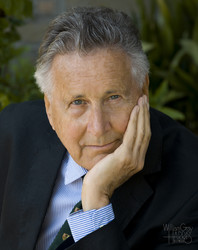
David Willey, veteran BBC foreign correspondent based in Rome for 50 years, sadly died aged 93 on July 11.
After reporting on the Treaty of Rome signing and then in Algeria, East Africa, Vietnam, and China, David was appointed BBC Rome correspondent in 1972 where he became well known and respected for his coverage and expertise on the Vatican as well as other Italian issues.
He was appointed an Officer of the Order of the British Empire (OBE) in 2003 and was still working into his 90s.
The AEJ UK has two tributes – from AEJ UK chair William Horsley, a BBC colleague for more than 30 years in Tokyo, Bonn and Europe, and Anthony Robinson, former Financial Times correspondent in Rome and Moscow and East European editor.
A Tribute to David Willey from William Horsley
The last time I saw David was on a beautiful sunny day in June 2024. He was already past 90 and severely restricted in his movement, yet he cheerfully accompanied me and other friends to lunch at a favourite lakeside restaurant near his home in the charming lakeside town of Trevignano Romano north of Rome. He gleefully told us about the weekly spot he was hosting with his ex-diplomat American wife Judy on a local radio station, where he enjoyed engaging with local people about current issues and the comings-and-goings of the sizeable community of foreign residents. And he recalled the exclusive visit he had made some years before to the monumental Pharoah-sized tomb, dubbed La Volta Celeste (The Vault of Heaven) that former prime minister Silvio Berlusconi had built for himself and his 36 fedelissimi — faithful friends and family — in the garden of the notorious villa outside Milan where he once hosted his ‘bunga bunga’ parties.
David was generous and unassuming but a consummate professional journalist, wise and deeply humane, and a unique font of knowledge about Italy and the Vatican. As a young BBC World Tonight radio producer I went to Rome in 1980 to make a programme with him about the phenomenon of Italian “black terrorism”, symbolised by the horrific bomb blast at Bologna train station in August of that year which killed 85 people. I recall going with David to interview an avowed neo-fascist politician whose desk was unashamedly adorned with the fasces, the traditional ancient Roman symbol of authority and power.
After a string of politically contested investigations, trials, acquittals, convictions and appeals, several culprits belonging to neo-fascists groups served lengthy jail terms, but the judicial process only ground to a halt in 1997. For me, that trip was an arresting encounter with the casual cruelty, violence and corruption that co-exist in Italy with high culture, characteristic civility, the ubiquitous legacy of imperial Roman history, and the bel figura of everyday life. Together those things make the paradox of modern Italy. In later years, when I lived in continental Europe and travelled widely in Italy and elsewhere as a BBC correspondent myself, those Italian contradictions only grew more vivid and perplexing. Yet Italy remains my favourite place to holiday.
During that first working trip, somehow (after a sumptuous restaurant dinner of wild boar with spicy chocolate sauce, a real delicacy) David and I missed our scheduled evening train to Naples. So we had to take the slow overnight train, fortified only by a bottle of Chianti. Reaching our destination at dawn, we headed straight to the Alfa Romeo car plant at Pomigliano d’Arco just outside the centre of Naples. Our mission was to investigate how the Camorra, the Neapolitan mafia, was threatening to bring the factory to its knees through constant strikes, disruption, and extortion of the company’s assets. That squeeze was clearly effective: strikes were rife, the production lines were hopelessly undermanned, and the management was demoralised. Roberto Saviano, the journalist who exposed the methods and political connections of the Camorra, has been forced to live in hiding or under close police protection for decades after numerous and repeated death threats.
For me, David was an inspiration. He reported on the signing of the Treaty of Rome in 1957 for Reuters, and then as a freelancer on the bloody Algerian war of independence in the early 1960s; his subsequent BBC stellar career took him to East Africa, and he covered the Vietnam war and the convulsions of Mao Tse-Tung’s Communist China, After some time as a London-based diplomatic correspondent travelling widely, his bosses asked him where he wanted to go next? David chose Rome, and he stayed.
David Willey wore his learning lightly, but he read Law and Modern Languages at Cambridge and he knew his stuff. I was present in London in 2002 when he delivered the prestigious annual Leconfield Lecture at the British-Italian Society on the theme of Justice Italian Style.
With erudition, David unravelled the labyrinthine system of dams, diversions and shallows that makes up the Italian way of justice: the multiple avenues open to defendants to delay and lodge appeals, the system’s openness to manipulation, and endemic tensions between the judiciary and politics. The meeting took place at the height of Silvio Berlusconi’s legal battles to rewrite Italy’s immunity laws and to use his huge media empire to paint the judges publicly as stooges of the extreme left.
David’s lecture was received with great enthusiasm by his audience. He knew how to navigate his way through the trickiest waters with integrity and charm. We shall not see his like again.
Memories from Anthony Robinson
It is sad to see another friend and colleague departed this life – but David and I, who were great friends in Italy and who kept in touch, spent many a happy hour reflecting on how lucky we were to spend our lives as foreign correspondents – when the living was easy and we were young enough to enjoy it!
We covered the rise of the Italian Communist party together and much besides. He loved Italy deeply and stayed on for another 50 years becoming ever more expert on Vatican politics and travelled the world with a succession of very different Popes who he got to know and be trusted by.
In Rome he lived in the Piazza del Collegio Romano in a fresco-ceilinged top floor apartment in a wing of Palazzo Doria before decamping to Trevignano on Lake Bracciano, 25 kms from Rome and still the source of much of Rome’s water carried through a Roman aqueduct.
During the gilded age of leisurely air travel, giant seaplanes would land on Lago Bracciano to refuel en route to Britain’s Imperial possessions in Africa and Asia. David, who died aged 93 and still lucid, became East Africa correspondent for the BBC, based in London but flying out frequently and staying at the best hotels, at a time when a BBC foreign correspondent was treated as a sort of ambassador.
Courteous and charming, he was the embodiment of an English gentleman, leavened by the Italian blood inherited from his Venetian mother. In Trevignano he lived with his American wife Judith, a writer, while his daughter from a previous marriage to Marie Claire lives in a nearby Etruscan village. The lake, which fills the crater of an ancient volcano, was at the heart of a thriving Etruscan civilisation before being replaced by Rome, but the villages they founded remain.
David spent his last years surrounded by an eclectic, cosmopolitan group of lively retired professionals, still broadcasting the odd despatch on Papal affairs when called on by the BBC.
I shall miss him, especially every time I go to Trevignano.