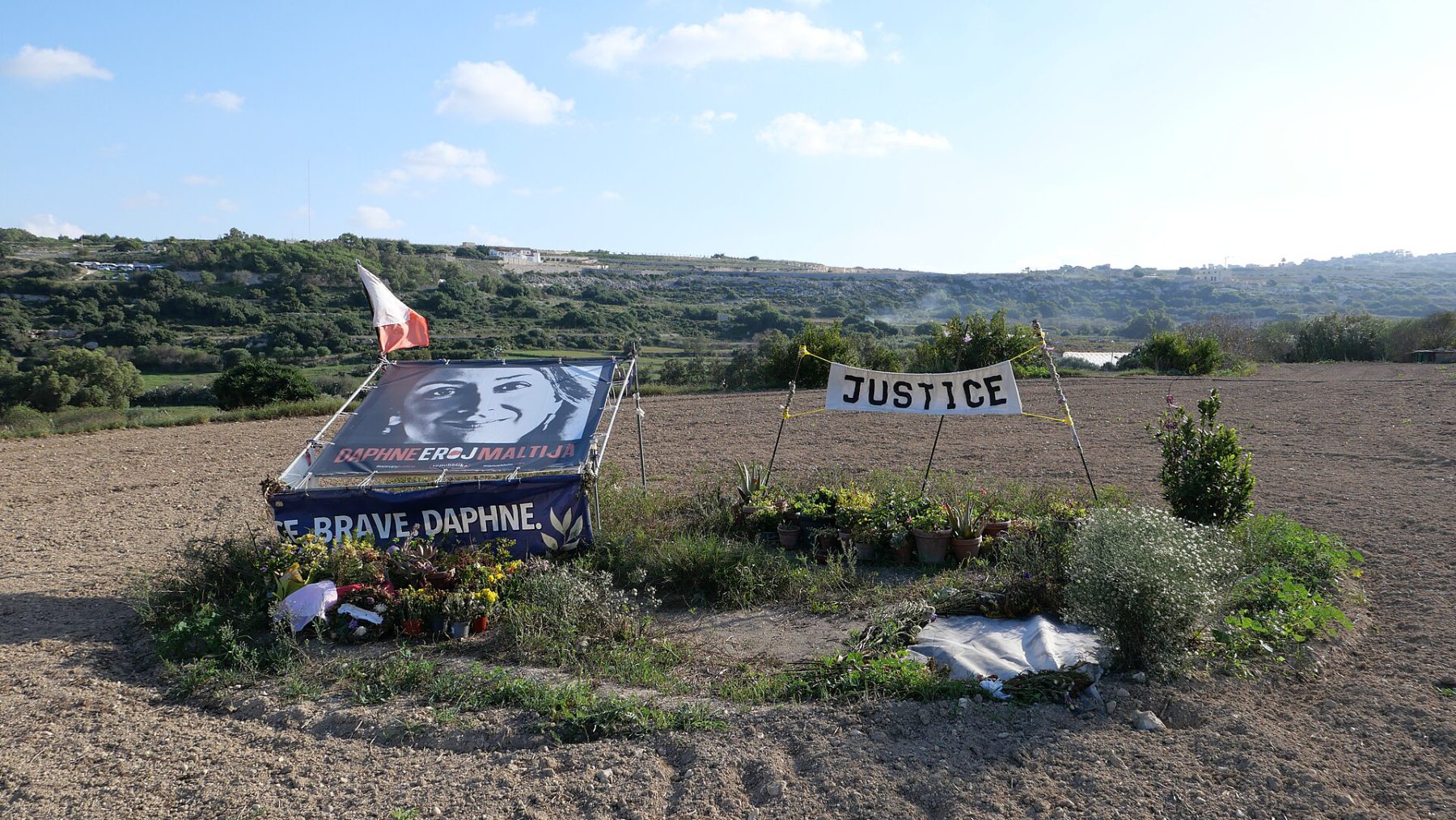
The Association of European Journalists has joined outrage in the international press freedom community at the acquittal of Maltese businessman Yorgen Fenech accused of masterminding the murder of investigative journalist Daphne Caruana Galizia.
The AEJ says it represents a devastating setback in the pursuit of full accountability for one of the most shocking assassinations of a journalist in Europe and leaves unanswered the central question of who ultimately commissioned the assassination as well as highlighting the continuing failure to establish full accountability for the murder of a journalist.
“We are beyond outraged. The verdict means that almost nine years since the assassination of Daphne Caruana Galizia, the Maltese authorities have failed to identify and convict the mastermind,” said Pavol Szalai, Director of the Prague Bureau of Reporters Without Borders (RSF).
The European Federation of Journalists (EFJ) has also condemned the outcome. EFJ President Maja Sever said:
“This court ruling amounts, quite simply, to denying justice not only to Daphne’s family, but also to the hundreds of thousands of journalists around the world who suffer as a result of the widespread impunity for crimes committed against their colleagues.”
And the International Press Institute (IPI) describes the acquittal as a “devastating setback” in the fight for justice for Daphne Caruana Galizia. IPI stressed that the verdict represents a major blow to efforts to combat impunity for crimes against journalists.
Fenech was acquitted by a jury on September 2 after a two-month trial.
Fenech, one of Malta’s richest men whose family owns two Hilton hotels and has a share in a power station in Malta, was tried for complicity to murder and for the lesser charge of criminal association to commit murder, accused of paying €150,000 (£129,000) via a middleman to have the campaigning investigative journalist killed in a car bomb near her house on 16 October 2017.
The jury voted 8-1 to acquit him after eight hours of deliberation.
The verdict is expected to be appealed against by the prosecution and a number of media freedom organisations have criticised it.
Fenech was first detained in November 2019 as he tried to leave the Mediterranean island before dawn aboard his luxury yacht. He denied the accusations, and his defence during the trial pointed fingers at his one-time close friend Keith Schembri, then chief of staff to then prime minister Joseph Muscat and a target of Caruana Galizia’s blogs.
Six days later Schembri resigned and less than a week later Prime Minister Muscat announced his own resignation following street protests and allegations of corruption made by activists and the opposition who said he had protected people linked to the murder.
Three men, brothers George and Alfred Degiorgio, and Vincent Muscat (no relation to the prime minister), were charged in 2017 for carrying out the actual bombing and all eventually pleaded guilty and were sentenced – Muscat in 2021 for 15 years in a plea deal to provide information and the Degiorgios for 40 years in 2022.
Two other men – Robert Agius and Jamie Vella – were jailed for life in 2025 for having supplied the bomb.
The middleman Melvin Theuma was granted a presidential pardon in 2019 in exchange for testimony.
Caruana Galizia had written extensively about suspected corruption in political and business circles in Malta, with investigative reports targeting people in Prime Minister Joseph Muscat’s inner circle whom she accused of having offshore companies in tax havens disclosed in the Panama Papers leak. She also targeted the opposition and business leaders in Malta.
An independent inquiry into the killing published in 2021 concluded that the Maltese state “has to bear responsibility” for the assassination due to a culture of impunity that emanated from the highest levels of government.
The family Daphne Caruana Galizia Foundation has campaigned tirelessly for justice in her killing and the AEJ has joined other media freedom and human rights organisations every year since 2017 in marking her death.
The AEJ’s long-serving UK chairman William Horsley and Marilyn Clark of the University of Malta published A mission to inform: Daphne Caruana Galizia speaks out (Council of Europe, 2020), a transcript of Daphne’s last recorded interview before her violent death. In it she spoke about a “climate of fear” in Malta surrounding the campaign of intimidation directed by figures close to the government.
AEJ condemns acquittal – AEJ International, 3 September 2026
Malta court clears businessman in Daphne Caruana Galizia murder – Reuters 2 September 2026
Prominent Maltese businessman acquitted – NPR (National Public Radio, USA) 2 September 2026
Timeline of an assassination – Reuters 2 September 2026
Sabotage, leaks and political ties in a murder trial – The Guardian 3 September 2026
The fight for justice must continue – Committee to Protect Journalists 3 September 2026
The search for justice – Index on Censorship 4 September 2026
Justice denied – Coalition Against SLAPPS in Europe 3 September 2026
Maltese authorities fail to identify and convict the mastermind – Reporters Without Borders (RSF), 2 September 2026
Justice denied – European Federation of Journalists, 2 September 2026
Devastating setback – International Press Institute (IPI), 2 September 2026
AEJ marks anniversary of killing – AEJ UK 15 October 2025
Inquiry finds state responsible for killing – AEJ UK 29 July 2021