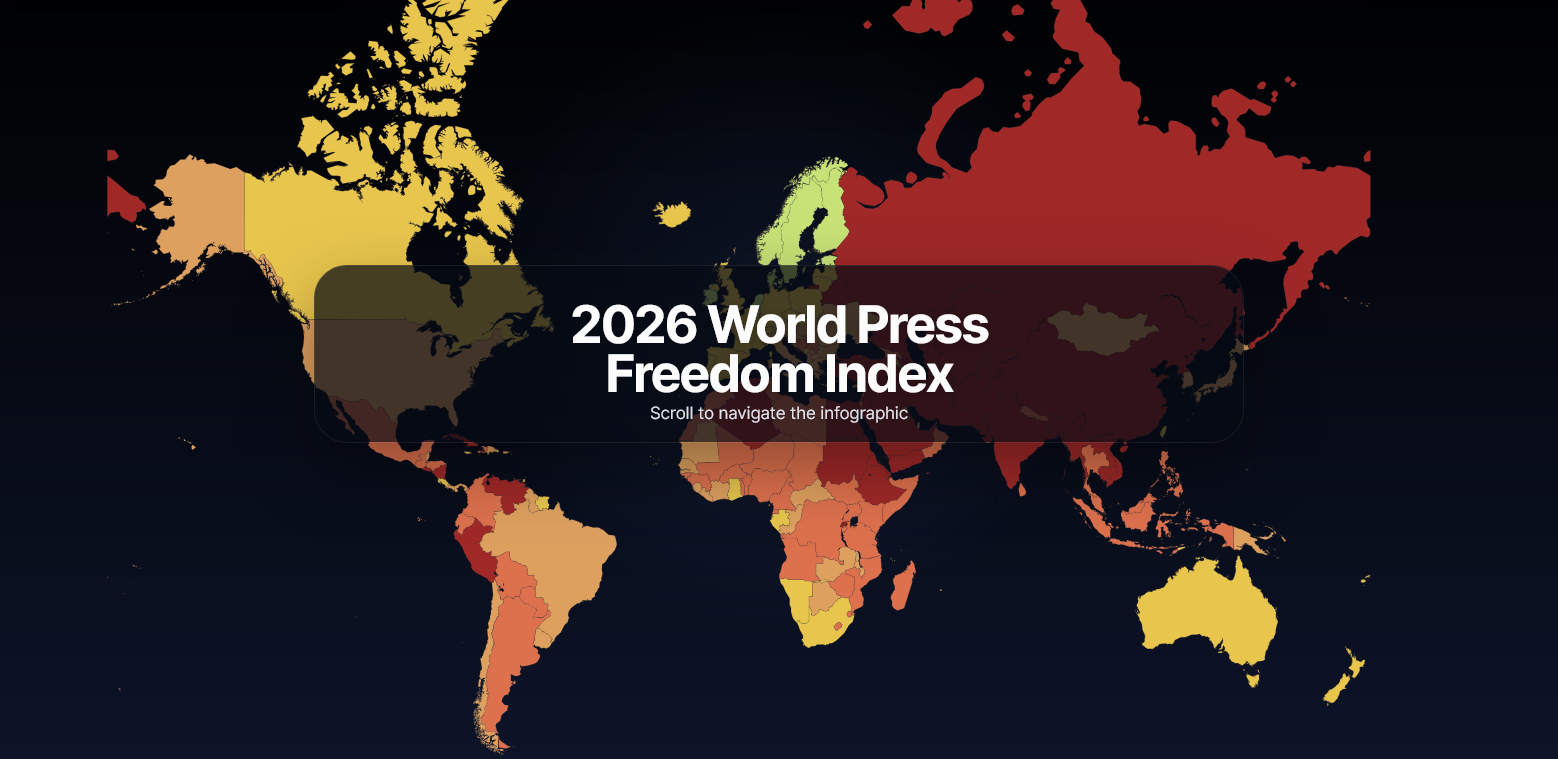
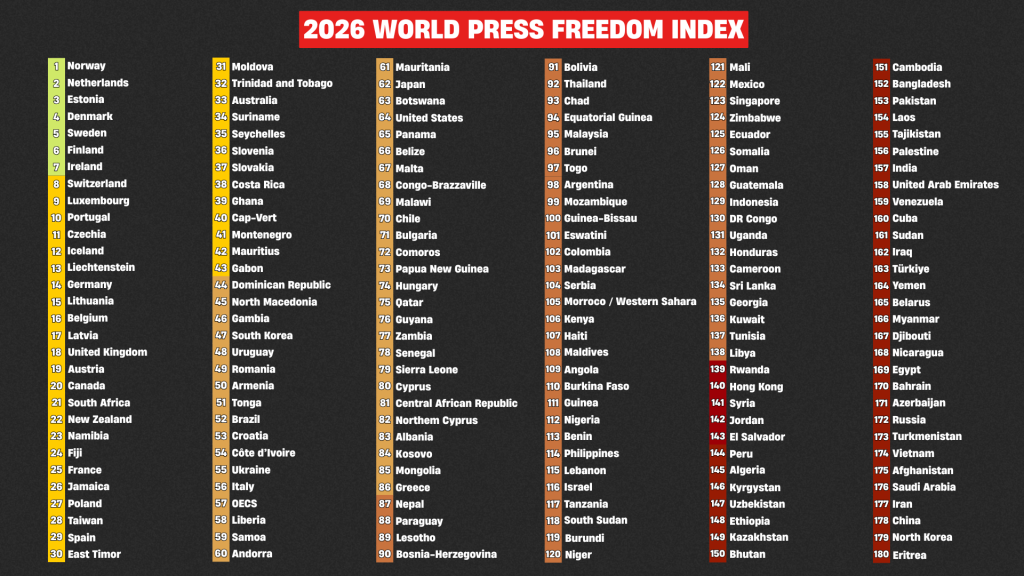
Reporters Without Borders (RSF) warns that media freedom is in its worst situation in 25 years with more than half the world’s countries now classified in the “difficult” or “very serious” categories for press freedom.
Marking World Press Freedom Day on May 3, the annual RSF World Press Freedom Index shows the steepest ever decline in 2025, “a clear sign that journalism is increasingly criminalised worldwide”, even in democratic countries, with the United States dropping seven places and several Latin American countries sliding deeper into a spiral of violence and repression.
Reporting Under Fire: Journalism, Conflict and Media Freedom – panel at the Cyprus High Commission London
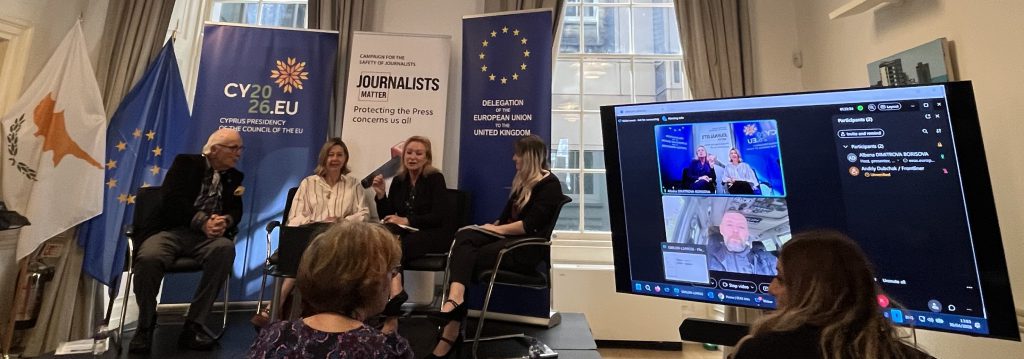
William Horsley, AEJ UK chair and former international Media Freedom Representative, reports on the EU sponsored panel on 30 April
Among the key findings are that the 2026 World Press Freedom Index shows press freedom has reached its lowest point since RSF started monitoring attacks on journalists 25 years ago, and the sharpest drop in 2025 was caused by state repression of media through the misuse of law. RSF also says 220 journalists have been killed in Gaza since the Israeli assault started in October 2023, of whom at least 70 died as a result of targeted attacks.
Felicity Garvey, RSF UK Advocacy Officer, said the environment for journalists in many parts had become so grim that the question now was “if they could survive long enough to bear witness”.
Christina Lamb, the Sunday Times’ chief foreign correspondent, said that with journalists in many places becoming a target of attack simply for their reporting, as well as atrocities in places like Sudan going unreported due to the extreme danger, and US President Donald Trump demonising journalists and intimidating the media, the international climate was one in which democracy was “dying in darkness”.
Andriy Dubchak, a veteran war reporter in Ukraine, said the task of reporting the war had become “super dangerous” because of the constant fear of drone attacks; many Ukrainian journalists were now burned out, and young newcomers were in desperate need of professional training. The extreme dangers today, he said, made the task of reporting the war in the earlier phase of artillery exchanges and infantry movements look like “child’s play”.
AEJ UK member Doros Partasides, whose photographs documented the 1974 war in Cyprus following the Turkish invasion, spoke of the vital role of journalists in reporting evidence of killings, torture and the mistreatment of countless civilians in situations of war and occupation.
In the RSF World Press Freedom Index, editorial director Anne Bocandé notes:
“By providing a retrospective of the past 25 years, RSF isn’t just looking back — it’s looking squarely at the future with a simple question: how much longer will we tolerate the suffocation of journalism, the systematic obstruction of reporters and the continued erosion of press freedom? Although attacks on the right to information are more diverse and sophisticated, their perpetrators are now operating in plain sight. Authoritarian states, complicit or incompetent political powers, predatory economic actors and under-regulated online platforms are directly and overwhelmingly responsible for the global decline in press freedom. Given this context, inaction is a form of endorsement. It’s no longer enough just to state principles — effective measures to protect journalists are essential and must be seen as a catalyst for change. This starts with ending the criminalisation of journalism: the misuse of national security laws, SLAPPs, and the systematic obstruction of those who investigate, expose and name names. Current protection mechanisms are not strong enough; international law is being undermined and impunity is rife. We need firm guarantees and meaningful sanctions. The ball is in the court of democracies and their citizens. It is up to them to stand in the way of those who seek to silence the press. The spread of authoritarianism isn’t inevitable.”
BBC World Service reports on a Forbidden Stories idea of a digital “safe box” to keep reporters’ work safe
Over the last five years, almost 200 journalists have been killed outside conflict zones, with reporters being murdered while investigating corruption, organised crime and environmental destruction. For World Press Freedom Day, People Fixing the World looks at the work of a pioneering organisation that is trying to help. Forbidden Stories, based in France, pledges to continue the work of journalists who have been killed, imprisoned or forced into exile. To help them do this, they encourage the use of a digital “safe box”, where reporters whose lives are at risk can keep notes and interviews, and which can be opened in the event of their death. This tool means that even if reporters die, their work can live on – but many reporters believe SafeBox helps keep them safe too.
RSF World Press Index report 2026