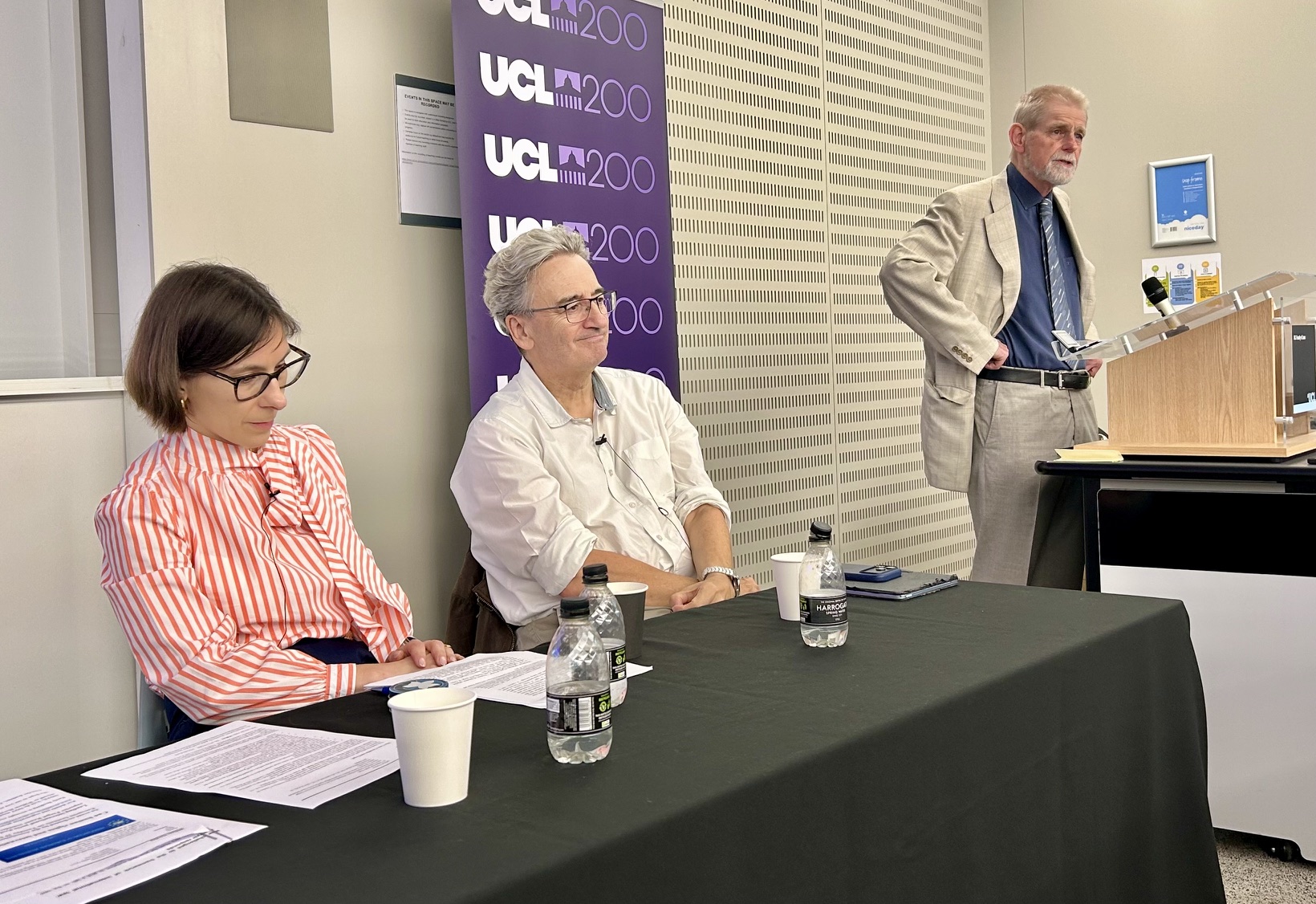
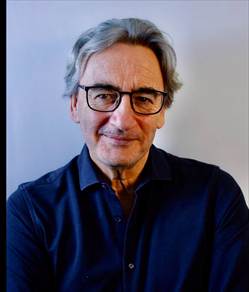
The AEJ UK and University College London hosted a debate about human rights and international law on 29 September with Veronika Fikfak, a leading international jurist, professor of human rights and international law at University College London, and a judge ad hoc at the European Court of Human Rights; and award-winning journalist and author Fergal Keane who has risked his life over four decades bearing witness to war crimes and crimes against humanity. He left the BBC earlier this year. His latest book is The Madness: A Memoir of War, Fear and PTSD (HarperCollins, 2026)
William Horsley, AEJ UK chair and debate moderator, has this summary of the meeting
Has the contempt for international law and fundamental rights shown by some powerful leaders already become normalised? That thought may have occurred to those who heard US President Trump’s recent address to the UN General Assembly, when he mused aloud about whether or not to “annihilate” Iran. According to the International Committee of the Red Cross a record 130 armed conflicts are raging around the world. And the United Nations is gridlocked. Are we condemned to live in a world where impunity protects the powerful from accountability for war crimes and whole populations lose the basic protections of international law?
This debate focused on three aspects of the question: Can international law and human rights prevail?
1. International lawyers warn that President Trump’s imposition of harsh personal sanctions on prosecutors and judges of the International Criminal Court in The Hague represents a concerted attempt to dismantle the international rule of law, the principle of judicial independence, and the accountability of governments. The U.S. also threatens sanctions against other states if they resist his demand for them to abandon the ICC and some have bowed to that pressure. Russia, too, has sentenced the ICC’s president and others to jail terms in absentia, after arrest warrants were issued against Mr. Putin and another official for the forced abduction of Ukrainian children to Russia. In November 2024 the ICC issued arrest warrants for Israeli prime minister Benjamin Netanyahu and another Israeli minister as well as a former Hamas commander, citing allegations of war crimes and crimes against humanity.
2. As a chorus of voices complains that human rights are “out of control”, the postwar framework of international human rights protections has been eroded and its legitimacy challenged by states’ open defiance of rulings by international and regional courts. What would it really mean for the rights of people in the UK if this country were to quit the Strasbourg court, as two UK political parties say they intend? The playbook of authoritarian governments involves manipulation of elections, politicisation of justice systems, and unchecked executive powers being misused to silence dissent and monopolise power.
3. The role of the news media in exposing corruption and serious abuses in the public interest is at acute risk globally from intimidating legal threats, social media distortion, and targeted acts of violence against media workers which routinely take place with impunity in countries across the world, as documented by UNESCO . More than 200 Palestinian journalists are reckoned to be among the over 70,000 people killed by Israel’s military onslaught on Gaza since 2023. A substantial number of those journalists died in targeted military attacks using sophisticated technology, while international reporters have been barred from entering Gaza in defiance of the laws of war which require that warring parties must protect journalists as civilians.
Extracts from the Speakers’ presentations:
Professor Veronika Fikfak: If you think about who is today declaring the death of international law, it is not the people of small island states, not people in Gaza, not women in Afghanistan, not people in Sudan… Instead, these people are the ones invoking it, relying on it, claiming its protection in very creative ways before domestic and international institutions… as a means of mobilisation.
Professor Veronika Fikfak: The media can amplify attacks on the institutions that hold power to account, or it can explain what those mechanisms do and why they matter. When those in power call judges – or journalists – “enemies of the people”, standing up to the bullies, as Fergal has urged, begins with refusing to adopt their language.
Fergal Keane: Over 30 years I’ve seen how the situation of war reporters, and cameramen and their helpers-fixers change in terms of their safety… It’s not just a question of impunity, it’s what we’re failing to do for ourselves, the stands we’re failing to take. I was struck by your remark about “failing to call things by their proper name”.
Fergal Keane: When I was in Israel in 2006 it came home to me that if I was killed by the Israeli Defence Forces there would be a bit of a kerfuffle and some protests, but no-one would be ever held to account… I know that because a few months before my good friend James Miller was shot dead by an Israeli sniper, and to this day nobody has been held to account. …It’s about the loss of liberty, of liberty of thought.
Fergal Keane: The darkness is growing and we are near the point of no return…Newspaper bosses need to stand up to the bullies. Journalists need to get out and tell their stories and be aware of international law… to know their rights and the rights of all the people being attacked; and where you see those laws attacked, expose it.
Professor Veronika Fikfak: Can human rights and international law prevail? Not on their own. Law does not enforce itself; it prevails when people refuse to let go of it. Those who want to escape accountability understand this very well – which is why they attack both the courts and the press. Our task, lawyers and journalists alike, is to make sure that when the moment for accountability comes, there is still a law to apply, an institution to apply it, and a record that cannot be denied.
Full text of Veronika Fikfak’s remarks
Thank you very much for your kind invitation to give a talk on the new challenges to international law and what it means for us lawyers. During the past couple of years, I am constantly being asked whether we are witnessing the death of international law and whether we lawyers will soon be out of a job. From the invasion of Ukraine, to the attacks on Iran and the atrocities in Gaza, the kidnapping of the President of Venezuela, to the humanitarian crisis in Sudan, every day we face ever new challenges to international law and human rights. In light of these events, even countries like Canada, with Mark Carney, have declared that “the old order is not coming back” and that we are living through “a rupture, not a
transition”.
So today I would like to address these challenges and ask how they compare to violations and challenges of the past – are they any different and if so, how; and if they are, where does this leave us. And because this is a joint meeting with journalists, I want to pay particular attention to the role of free expression – and of those who bear witness – in holding states to account.
So what types of challenges are we currently facing? I am sure these w ll be familiar to many of you:
In addition to what was said before, on climate – states are refusing to respect the obligations they have signed, and even when specific judgments are delivered, are pushing back to say they are doing enough to combat climate change;
More broadly, the US has announced its withdrawal from 66 international organisations and treaties, the UK has left the European Union and is contemplating leaving the European Convention on Human Rights.
International institutions are under attack – the International Criminal Court has been sanctioned, along with its Prosecutor and judges; other international institutions have been facing financial difficulties – the UN has had its budget considerably reduced by the failure of certain states to the pay their dues, the European human rights system has faced similar problems.
The question is how these behaviours differ from violations and challenges to the international legal order in the past.
When I think back to growing up in the 1990s, we also had wars and atrocities – we had genocide on our doorstep. I am Slovenian and was raised in the former Yugoslavia, and everyone remembers Srebrenica. Then came the NATO bombing of Yugoslavia in 1999 without Security Council authorisation, and in 2003 the invasion of Iraq. I thought then that the whole system of international law was not functioning – that it was in crisis. And yet, we referred to international law – what it allows and what it does not all the time.
This I think has remained the same. And this is my first point. If you think about who is today declaring the death of international law or international legal order, it is not the people of small island states, not people in Gaza, not women in Afghanistan; not people in Sudan.
If you look closely at what these people – the individuals who actually experience international law being broken every day – are doing, they are not disillusioned by international law. To these people and communities, international law provides a framework against which they can measure what has occurred and what is occurring; a framework that gives them the language through which they can explain what is happening; and labels around which they can organise and mobilise.
As in the 1990s, therefore, what has not changed – is that those who need international law’s protections are relying on it consistently, in spite of the violations, in spite of the disregard shown by others. So it is hard to say that international law is dead.
In fact, many states have used international law to create more institutions and international processes to prevent impunity for the invasion.
– After the invasion of Ukraine, for example, international law was used to create a Register of Damage for Ukrainians affected by the war; a Special Tribunal for the Crime of Aggression against Ukraine has been established with the Council of Europe; we are still debating how to use international law to confiscate Russian assets and help Ukraine finance the war; and the ICC has issued an arrest warrant for President Putin, with serious debate about the limits of
immunity – for instance when Mongolia failed to arrest him on a visit – to ensure he can be prosecuted.
– These are all mechanisms that have been developed through international law to respond to violations of international law.
One might argue that it is of course a shame we have not seen similar mobilisation in response to other serious uses of force, above all in Gaza. But even here, with the Security Council deadlocked by vetoes, the law has not been silent. South Africa brought a case against Israel under the Genocide Convention, and the International Court of Justice ordered provisional measures. The ICJ has also given an advisory opinion on the unlawfulness of Israel’s occupation of the Palestinian territory. The ICC has issued arrest warrants for Prime Minister Netanyahu, his former defence minister and a Hamas commander. And the UN Commission of Inquiry has concluded that genocide has been committed in Gaza.
But I do not want to overstate this. None of those named in these arrest warrants has yet stood trial. President Putin was received with full honours in Mongolia, a state party to the Rome Statute. Prime Minister Netanyahu was welcomed in Hungary, which then announced it would leave the Court. And in Sudan, where famine and mass killings in Darfur have created one of the worst humanitarian catastrophes in the world, the international response has been close to silence. So the law has spoken – but for now, the powerful have largely not been made to answer.
That is the honest picture. But this does not mean that nothing has changed – What is different? This brings me to my second point.
The big game changers have been withdrawals from international treaties and institutions: Brexit, the 66 US withdrawals, the potential withdrawal from the ECHR. The decisions to pull out of international agreements threaten the international legal order because they mean that international law no longer applies. If there is no human rights law that applies, it means we can no longer call something a human rights violation. But the implications are bigger. If we have no international law, no international institutions that have jurisdiction to hear claims about breaches, then there is a danger that no one holds states to account.
The attack on the International Criminal Court belongs in the same category, and it is new. The United States has not simply refused to cooperate with the Court – it has sanctioned its Prosecutor, his deputies and a number of its judges, in what is now openly described as an effort to “dismantle” it. These are individuals who have their assets frozen, who
are cut off from banking and everyday services, and whose colleagues risk penalties for helping them. The message is not aimed at a single case. It is aimed at every judge and every prosecutor who might one day consider investigating the powerful: do your job, and you will pay for it personally. It is an attempt to make sure that violations can no longer be
judged at all.
This is also where my concerns about withdrawal from the European Convention on Human Rights come in. As you know, the Tory party has now joined Reform in calling for the withdrawal from the European Convention after the next election. The argument is that withdrawing would mean we could be in charge of our borders, that we could send
illegal migrants back, that we could again claim sovereignty from Strasbourg. Now we can of course discuss the details of the migration reform, but it seems to me that for more than a decade, we have been debating how bad foreign courts are – first Luxembourg, now Strasbourg. How they constrain parliamentary sovereignty. How they prevent the government from doing what it wants to do. We are told that human rights have got “out of control”.
The reality, however, is that it is the normal, constitutional role of any top court, whether international or domestic, to provide checks and balances, to protect the most vulnerable, the voiceless. Often these individuals are overlooked by the majority in power. The only way for them to seek protection is through courts.
And yet – judges at international and domestic level are being vilified for what they do. If we remember the Gina Miller saga, when after the Brexit referendum result, the High Court and the UK Supreme Court were asked to rule whether constitutionally parliament had to provide approval for the UK to leave the European Union, newspapers labelled the judges ruling on this matter as privileged, biased, and even called them “enemies of the people.” These were not foreign judges. They were our own judges.
I mention this deliberately, in a room full of journalists. That headline was a choice. The media can amplify attacks on the institutions that hold power to account, or it can explain what those institutions do and why they matter. When those in power call judges – or journalists – “enemies of the people”, standing up to the bullies, as Fergal Keane has urged, begins with refusing to adopt their language.
This is also how normalisation happens. Atrocities do not become normal when they are committed – they become normal when we stop calling them by their name. When aggression becomes a “special military operation”, when the kidnapping of a head of state becomes a “bold move”, when the killing of civilians becomes “collateral damage. The
vocabulary of international law – aggression, war crimes, crimes against humanity, genocide – exists precisely so that these things cannot be quietly absorbed into the everyday. Using that vocabulary accurately is not activism. It is accuracy.
And so it is clear to me that the discussion about UK withdrawal from the Convention or withdrawals from international agreements in general is less about Luxembourg and Strasbourg or The Hague than about the judiciary in general, and about its constitutional role to scrutinise and limit the scope of governmental power, to require specific processes to be
followed, to impose accountability on those in power. And if we look who are the countries that no longer wish to be bound by international law, these are the same countries that declare the current legal order dead – US, Russia, some elements of the UK.
This brings me to my third point: the role of journalists. Journalists play a key role as watchdogs, bearing witness to abuses and ensuring that states are held to account.
In relation to international law, journalists do two things. First, they enable international institutions to do their work. Courts, commissions of inquiry, special rapporteurs and prosecutors can only respond to what they know about. Very often it is journalists who bring atrocities to light and document them, and whose reporting becomes the record that institutions later rely on.
Second, journalists help individuals mobilise. They make people’s battles public. By bringing violations to light, they give victims and their families visibility and support, and very often the evidence they need to bring their claims before international institutions in the first place.
At the heart of both is freedom of expression. Without the freedom to investigate, to publish and to protect sources, neither of these things is possible.
International institutions are well aware of this, and they have protected journalists through international law in a number of ways. It was the European Court that held, in the Sunday Times case in 1979, that the newspaper could not be gagged from reporting on the thalidomide scandal. In Goodwin v United Kingdom in 1996, Strasbourg held that a
journalist cannot be forced to reveal their sources except in exceptional circumstances. It called the protection of sources “one of the basic conditions for press freedom”. And in Big Brother Watch in 2021, Strasbourg found that the UK’s bulk interception regime breached the Convention, in part because it did not adequately protect confidential
journalistic material. So when we discuss leaving the Convention, we are also discussing the legal foundations of a free press in this country.
But this is also why journalists are targeted, just like international institutions. The same logic that leads to sanctions against the ICC and its judges leads to attacks on those who bear witness. The Committee to Protect Journalists recorded 2024 as the deadliest year for journalists it has ever seen, and most of them were killed in Gaza. According to
UNESCO, when a journalist is killed, in around 85 percent of cases no one is held to account in the last 20 years. Impunity on this scale is not an accident. It is a choice made by states.
And international institutions say so. The duty to investigate deaths properly and independently, has been international institutions’ answer. The European Court found Ukraine responsible after the murder of Georgiy Gongadze. It found Turkey responsible for failing to protect Hrant Dink despite warnings of the plot against him. It found that Russia had
failed to investigate the murder of Anna Politkovskaya properly, because the investigation never established who ordered the killing. In Malta, the public inquiry into the murder of Daphne Caruana Galizia was held only after sustained pressure from her family and the Council of Europe. It concluded that the state bore responsibility for creating a climate of impunity. And in the case of Jamal Khashoggi, no court was available and the Security Council did nothing. It was a UN Special Rapporteur, Agnès Callamard, who investigated and set out the evidence of Saudi state responsibility.
International institutions and journalists are therefore mutually reinforcing. Both bring to light what is happening. Both give victims a path to accountability and justice. Institutions rely on journalists to know what has happened, and journalists rely on institutions to protect their freedom to report it and to make sure that what they expose has consequences.
It is no coincidence, then, that both are under attack, and in very similar ways. Sanctions, cuts to their budgets, court packing and non-compliance with their judgments are tools used to weaken international institutions. Killings, threats, surveillance and, increasingly, lawfare in the form of SLAPPs are tools used against the media. But these are not only attacks on individual journalists or on individual institutions. They are attacks on the mechanism through which violations become known, and therefore on the possibility of accountability itself.
So, are we condemned to a world where impunity protects the powerful? I want to answer that honestly. Today, those facing arrest warrants travel and govern, and in Sudan whole populations are being abandoned with barely a response. Accountability is not at the top of the political agenda.
But I grew up in Slovenia, on the doorstep of Srebrenica. In 1995, it looked certain that no one would ever answer for genocide. In 2017 – twenty-two years later – Ratko Mladić was convicted of genocide and sentenced to life imprisonment. Pinochet was arrested in London. Charles Taylor, indicted while he was still a sitting head of state, was convicted and is serving his sentence. Arrest warrants do not expire, and genocide has no statute of limitations. Impunity is a choice made by states – which means it can be unmade. But only if, when the moment comes, the evidence exists, the institutions still stand, and the rules have not been abandoned in the meantime.
So what is to be done? Three things.
First, keep the institutions alive. That means paying our dues, protecting courts, their judges and prosecutors from sanctions and intimidation, and complying with judgments ourselves. We cannot credibly demand that Russia respect international law while we debate leaving the European Convention on Human Rights. But it also means bringing the work of international institutions closer to the general public, it means explaining what good these institutions do, what role they play, and educating the public where we would be without them.
Second, preserve the record. Every atrocity documented today – by investigators, by commissions of inquiry, and above all by journalists – is evidence for a trial that may come in ten or twenty years. Much of what eventually convicted those responsible for Srebrenica – intercepts, aerial images, footage, testimony – was gathered while the war was still going
on or soon after.
Third, refuse normalisation. Call aggression aggression. Name war crimes and genocide when the evidence shows them. Keep the international language and terminology alive. Do not repeat the language of those who call judges and journalists “enemies of the people”.
Can human rights and international law prevail? Not on their own. Law does not enforce itself; it prevails when people refuse to let go of it. Those who want to escape accountability understand this very well – which is why they attack both the courts and the press. Our task, lawyers and journalists alike, is to make sure that when the moment for accountability comes, there is still a law to apply, an institution to apply it, and a record that cannot be denied.
Thank you.
Veronika Fikfak and Fergal Keane with the AEJ UK 29 September 2026

US announces sweeping sanctions on International Court of Justice – AEJ UK 10 October 2026